Canberra,
Australian Capital Territory.
Ninth
World Congress on Art Deco.
Pre-congress program presented by the Twentieth Century Heritage
Society of NSW, 12th-15th April, 2007.
_______________________________________________________________________
Notes by Roy Lumby
Over a period of four days, society members
and guests from interstate and overseas visited some of Canberra's
outstanding twentieth century buildings:
University House was one of the very first
buildings constructed on what was then the campus of the University
College of the University of Melbourne. Designed by Professor
Lewis and constructed by Howie Moffat & Co of Sydney,
it was completed in 1953 and awarded the Sulman Medal for
1953. The Duke of Edinburgh officially opened the building
during the Royal Visit of 1954. The building is a reworking
and mildly modernised version of the tradition of English
University college quadrangles. Here a shady verandah and
a wide pool encourage one to linger and enjoy the tranquillity
of the quadrangle itself. Furniture within the building is
mostly original, the work of Melbourne designer Fred Ward.
The Australian War Memorial on the site designated
for a casino on Griffin plan. Decision to erect the War memorial
on axis with Parliament House in 1923. More>
Nicholls Collection at the National Library of Australia,
situated near the intersection of King Edward Terrace and
Parkes Place West in Parkes, was designed by the Sydney-based
architectural firm of Bunning & Madden in association
with T E O’Mahoney. The Library originally formed part
of the Commonwealth Parliamentary Library but only received
separate status in 1960. An earlier (1934) building housing
the Library, the first stage of a much larger building that
did not eventuate, was situated on Kings Avenue but demolished
in the early 1970s.

Australian National Gallery: Col Madigan of Edwards,
Madigan, Torzillo & Briggs of Sydney, 1982. Reworking
of a competition entry originally intended for Capital Hill.
More>
Provisional Parliament House
designed by John Smith Murdoch, Commonwealth Architect of
the day. Officially opened by the Duke of York in May 1927,
the building was only intended as a provisional structure.
Nevertheless it served the nation for 61 years. Griffin had
proposed Camp Hill as the site of houses of parliament, but
a Parliamentary Works Committee seems to have guided a decision
to locate the building in front of and below Griffin’s
site.
The National Archives of Australia located
in the former Secretariat buildings on Queen Victoria terrace,
are the siblings of Old Parliament House and were completed
in 1925 (the East Block) and 1927 (the West Block). They too
are the work of John Smith Murdoch and share the same architectural
vocabulary and use of materials. Canberra’s original
post office was situated in the East Block. Conservation works
in 1998 to convert to National Archive.

One of the most memorable buildings in Canberra must be the
Australian Academy of Science’s building, the Shine
Dome, (formerly Becker House). More
>
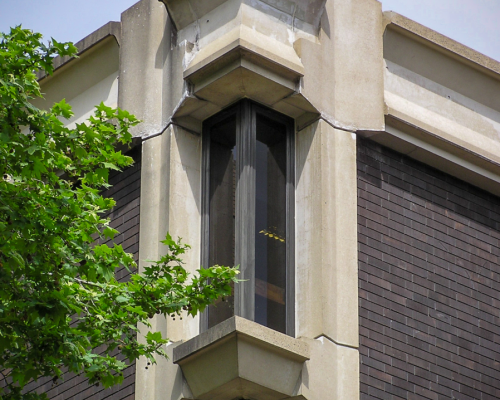
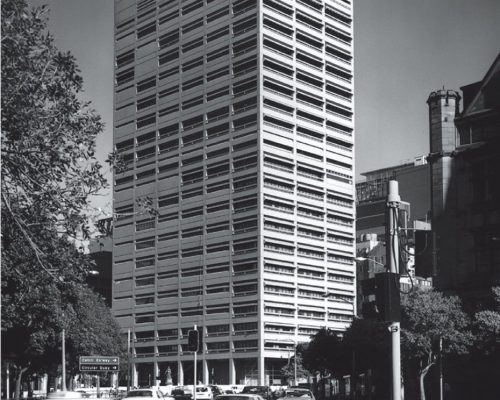
The intriguing former English Scottish and Australian
Bank Building at 17 London Circuit was designed by
one of the bank’s staff architects, Stuart McIntosh,
and completed in July 1963. The firm of Yuncken Freeman Architects
supervised construction. McIntosh designed a large number
of suburban branch buildings for the Bank during the 1950s
Control of sun penetration is achieved by the horizontal blades
that vary in thickness and appear to float across three facades
of the building. The blades are fixed to a structural steel
cantilevered frame bolted to the edge beams of the structure.
The canopy marking the entrance (which also collects rainwater
from the other blades) is made prominent because of its placement
on one end of the University Avenue façade, while slender
subsidiary blades reinforce corners in the manner of quoins.
According to Professor Robert Freestone “the precincts
developed for the first permanent housing in Canberra in the
1920s have matured into the most substantial and distinctive
suburban environments inspired by the Garden City movement
in Australia … no other Australian city boasts such
an extensive set of self-consciously designed and controlled
projects from this era. These early precincts set the standard
for the manicured landscapes which are now the essence of
Canberra”. Amongst these is a precinct of dwellings
that is included in the City’s planning instruments
as the Reid Conservation Area. The Conservation
Area falls in the area enclosed by Limestone Avenue, Coranderkk
Street, Booroondara Street and Anzac Avenue.
The Former Canberra High School, axially
aligned with Childers Street, was opened in 1939. More>
The former Patents Office (now known as the
Robert Garran Offices) in National Circuit, Barton, was designed
by Cuthbert Whitley of the Department of the Interior and
completed in 1941. It was built by Concrete Constructions
Pty Ltd. The austere and dignified Stripped Classicism, that
Whitley seems to have favoured for public buildings has been
overlain with sufficient decorative detail (some of it Art
Deco), particularly at the main entrance, to avoid dullness
and results in a satisfying and understated work. The building
is faced with Hawkesbury sandstone.
St Paul’s Church of England, Griffith
Canberra Avenue and Captain Cook Crescent, Griffith. Burcham
Clamp & Son 1939 consisting of four bays, and 1956 additions
that included the rest of the nave and the tower. The first
Anglican church in Canberra. Hints of Griffin – Clamp
took Griffin into partnership after he arrived in Australia
1914-15 for all of nine months.
Modernist house at 107 Limestone Avenue,
Braddon, was designed by Cuthbert Whitley and completed in
1940. More>

The Manuka Swimming Pool in Manuka Circle,
Griffith, was completed in 1930. The complex was the work
of the Federal Capital Commission’s Edwin Henderson
in association with H G Connell. Only swimming pool for about
200 miles when completed.
The Roman Catholic Cathedral was originally intended for a
site just to the south of the City precinct and would have
overlooked Lake Burley Griffin, but the proposal fell victim
to the depression. St Christopher’s Roman Catholic
Cathedral, situated on Manuka Circle and Furneaux
Street in Griffith, started off as a church attached to a
convent and school. The building was designed by Sydney architect
Clement Glancy, who was responsible for a vast amount of work
for the Roman Catholic Church during the interwar era, as
a cream brick version of what might be termed Stripped Romanesque.
The church was opened by Prime Minister Robert Menzies in
1939. It became a Pro-Cathedral in 1948, then a Co-Cathedral
in 1955. The building was enlarged in 1973 to the design of
Clement Glancy junior – the nave was extended and the
Chapel of the Blessed Sacrament and the campanile constructed.

The blocky Forrest Fire Station, overlain
with hints of Stripped Classicism, is just one element of
the group of buildings in the block contained by Canberra
Avenue, Empire Circuit, Fitzroy Street and Manuka Circle.
More>
Calthorpes’ House at 24 Mugga Way, Red Hill
was designed by Kenneth Oliphant of the Melbourne firm of
Oakley & Parkes, who oversaw the construction of what
is now the precinct known as Forrest, and completed in 1927.
The house is rather formal, with two projecting wings terminated
by shady loggias forming a sheltered court, but because of
this has an engaging relationship with its site. The loggias,
warm toned cement rendered walls and decorative elements such
as exposed rafter ends and small circular vents in the loggia
gables are all hallmarks of the Inter War Mediterranean style.
The house is less remarkable, however, for its architecture
than for the fact that its interiors still contain the Calthorpe
family’s original furnishings and artefacts from the
1920s onwards, making it a unique record of everyday life
in early Canberra. Harry Calthorpe was a successful stock
and station agent when Canberra was founded. He later ventured
equally successfully into the realm of real estate. The Calthorpe
family occupied the dwelling until Mrs Calthorpe died in 1979,
after which it was taken over by the ACT. It is now a justly
famous house-museum.

The former Institute of Anatomy (now ScreenSound
Australia) must be one of Australia’s finest Inter War
Stripped Classical style buildings. More>
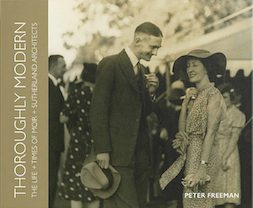
The Moir House at 43 Melbourne
Avenue, Forrest, was designed by architect Malcolm Moir for
his own family and completed in 1936. Malcolm Moir was born
in 1903, studied under Leslie Wilkinson at the University
of Sydney and graduated in 1924. In 1927 he moved to Canberra
to join the architectural department of the FCC. After the
FCC was disbanded Moir set up his own practice in 1931 and
became one of the city’s most important architects designing
Modernist buildings. In the second half of the 1930s he married
Heather Sutherland; the firm of Moir and Sutherland continued
until her death in 1953. The firm subsequently evolved into
Moir Ward & Slater then Moir & Slater during the 1960s.
This house is considered to be the best of the Canberra houses
that Moir designed. Its rectilinear Modernist forms, executed
in warm toned brickwork and offset by occasional curves, contain
four levels. All major living spaces are oriented to the north
to take advantage of the sun. The prominent lightweight glazed
structure is a later addition, designed by Moir as his own
studio-office. The Moir family occupied the house until Malcolm’s
death in 1971.
Main picture: Shine Dome,
Australian Academy of Science.

|